|
The changing technology of television production and digital services to viewers means the ways for moving content - programme video and audio - in studios is changing too. Not only is there far greater use of computers and IT-related products, such as servers, but also reliance on automation and the re-use of material have expanded. Besides the need to carry metadata, file transfers are needed to fit with computer operations and streamed for real-time operations.
The development of the Material Exchange Format (MXF) is a remarkable achievement of collaboration between manufacturers and between major organisations such as Pro-MPEG, the EBU and the AAF Association. It establishes interoperability of content between various applications used in the television production chain. This leads to operational efficiency and creative freedom through a unified networked environment.
MXF is a file transfer format, which is openly available to all interested parties. It is not compression-scheme specific and simplifies the integration of systems using MPEG and DV as well as future, as yet unspecified, compression strategies. This means the transportation of these different files will be independent of content, not dictating the use of specific manufacturers' equipment. Any required processing can simply be achieved by automatically invoking the appropriate hardware or software codec. However, MXF is designed for operational use and so all handling processes are seamless to the user. It just works!
Besides offering better interoperability - working with video and audio between different equipment and different applications - the other major contribution is the transport of metadata. By developing MXF from the beginning as a new file format, considerable thought has gone into the implementation and use of metadata. Not only is this important for the proper functioning of MXF files, it will also enable powerful new tools for media management.
MXF is a file format for the exchange of programme material between servers, tape streamers and to digital archives. Its contents may be a complete programme as well as complete packages or sequences. There are basic facilities available for cuts between sequences and audio crossfades. This way the sequences can be assembled into programmes. MXF is self-contained, holding complete content without need of external material.
MXF bundles together video, audio, and programme data, such as text - together termed essence - along with metadata and places them into a wrapper. It's body is stream based and carries the essence and some of the metadata. It holds a sequence of video frames, each complete with associated audio, and data essence, plus frame-based metadata. The latter typically comprises timecode and file format information for each of the video frames. This arrangement is also known as an interleaved media file.
The body can be based on several different types of material (essence) including MPEG, DV and uncompressed video and audio, it also uses the SMPTE KLV data coding system, which has the advantage of being a recognised standard.
In 1999, work started within Pro-MPEG Forum to establish a universal file format for the interchange of programme material between file servers and workstations. Although networking and file transfers are already commonplace in broadcasting they are mostly based on proprietary formats, which may have restricted functionality and are not fully interoperable. Typically, although the video and audio are preserved, metadata is for the most part not carried, ignored or lost.
For users, the aims for the new format were that it should be:
- Easy to understand and apply
- Open and, when ready, standardised
- Compression-independent
- Useable on major platform operating systems and networks
MXF is targeted at professional video and broadcast applications, which excludes consumer applications at one end and complex editing and authoring at the other. It is designed to carry continuous programme material and metadata (see "What is MXF?"). Typical applications are carrying newly shot material and finished programmes. This targeting keeps MXF relatively simple and efficient as it
avoids the complexity and overheads needed for editing and authoring. However, it is designed to interoperate with those areas. So Pro-MPEG and the AAF (Advanced Authoring Format) have and are
continuing to work together to ensure their formats are compatible (see MXF and AAF).
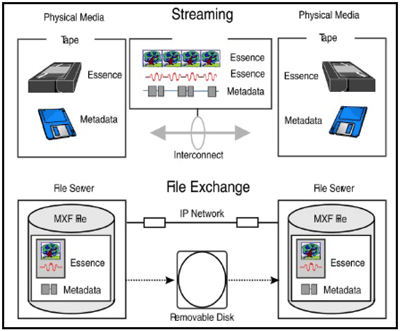
Traditionally broadcast television has been built around streaming video and audio. This is logical as the original scene action and the viewer expectation is of continuous real-time video and audio - supported by continuous streaming. PAL and NTSC analogue composite video, and digital SDI (serial digital interface) and SDTI (serial digital transport (data) interface) all stream. But computer systems exchange data by file transfers.
Streaming media:
- Is viewable during transfer - before all the data is delivered
- Offers minimum delay for live action
- Is point-to-point with no bottlenecks: offers reliable, continuous operation
Networked media:
- Uses low-priced, standard IT components
- May be stored on a wide variety of devices including disks and tape
- Offers flexible data exchange, sharing and distribution
Both real-time streaming and file transfer have their advantages and both will continue in use. Therefore, it is essential that both have some degree of compatibility so they can co-exist and allow material exchange between them. With this in mind, the design of MXF makes it a file format that can stream - creating a seamless bridge between the two transfer types. Operationally, there is no effort involved beyond requesting the transfer. So, for example, advantage can be taken of the flexibility of AAF in postproduction and, via 'invisible', simple file conversion, MXF for the finished playout to tape streamer or server storage. Note that the file
conversion is loss-less for video and audio, if the compression scheme is not changed.
In a similar way, operational and creative staff want to concentrate on their tasks and not bother with compression issues. But is it also true that no single compression format will suit all applications and various schemes will continue to be used. Therefore MXF is compression-independent, offering the same service regardless of the compression in use. This allows manufacturers to provide equipment with multiple compression codecs, which could lead to seamless working between, for example, MPEG and DV-based systems.
MXF is an open solution and so has been submitted to SMPTE for standardisation. Together, the Pro- MPEG Forum and AAF Association have support from a substantial cross-section of the industry. In addition, close collaboration with user groups, such as the EBU, ensure that users' needs are incorporated. At the same time, many manufacturers and suppliers of software and hardware are keen to implement MXF as soon as possible.
As mentioned, in a move towards early standardisation, MXF already adheres to SMPTE KLV guidelines (Key, Length, Value - a method for wrapping data for transport over networks).
Achieving interoperability is the prime objective of Pro-MPEG and MXF. This has been implemented in three areas.
Cross-platform. It will work across different network protocols and across operating systems including Windows, Mac, OS, Unix and Linux.
Compression independent. It does not convert between compression formats; it does make managing more than one in a single environment easier. It can handle uncompressed video.
Streaming / transfer bridging. MXF interoperates seamlessly with streaming media - especially SDTI where fully transparent interchange is achieved. This performance is bi-directional: achieved going from
MXF to streaming and vice versa., and means SDTI fits easily into a file-based environment. This is true convergence.
A major aim of MXF is the seamless passage of programme content and its associated metadata. Also referred to as 'data about data' it exists in any system today. For example, timecode is a
form of metadata. The problem is that, due to incompatibilities, this information is currently lost as the content moves between systems. MXF-enabled systems will communicate using metadata, video and
audio. MXF metadata may carry information about:
- The file structure
- The body contents - e.g. MPEG or DV, 525 or 625, etc.
- Key words or titles
- Subtitles
- Reference numbers
- Editing notes
- Location, time, date and version number
- .....
The list may be endless. In extreme cases files may contain more metadata than video or audio content! However, the efficient implementation of metadata is seen as the key to material management. The
metadata may be filtered to hold only what is relevant to the particular operational environment, thereby cutting possible meta-mountains.
It has no need to carry the editing 'EDL' information. If the content has come from an edit session, the editing data will have been used to conform the material and so has no further use here. Should full edit archiving be required it should be performed as a part of the editing operation, before outputting to MXF. (See "What is MXF?")
The speed of progress of MXF is a tribute to the many dedicated engineers across the industry working together towards a common objective. Manufacturers and users both recognise that there is a window
of opportunity to establish an industry file format standard. The use of video will increase into an expanding array of broadcast and allied applications, as will the use of IT and servers. Any delay in establishing standards will make the task more difficult as proprietary solutions will spread into the format vacuum.
Advanced Authoring Format (AAF) is an industrydriven open standard for multimedia authoring and postproduction. It enables content creators to easily exchange digital media and metadata across platforms and between applications. It simplifies project management, saves time and preserves valuable metadata that was often lost in the past during media transfers.
MXF is derived from the AAF data model and is a simple interchange format, primarily to facilitate the transfer of finished content, whole programmes or completed sections, between servers and to tape streamers. MXF also helps with the migration of playout operations and simpler production systems into standard networked environments.
The two formats are especially complementary. Whereas AAF integrates closely with, and complements, existing media file formats, MXF offers the same for existing stream formats as well as AAF files. Both formats can stand on their own and each has a functionality and design optimised for their particular spheres of application. At the same time, one does not depend on the other. For example, a whole broadcast system may use only MXF and a postproduction house, just AAF, but a broadcaster with a post facility may well use both.
While the MXF and AAF are complementary, there are many differences. One is that AAF may carry references to outside material held in other places, to be used in an edit whereas MXF is always complete and self-contained: not requiring any access to outside material. In addition AAF includes basic video transition processing whereas MXF, carrying completed programme material, has no need of that.
MXF is driven by user needs and so has a strong commercial base. Even normally competitive manufacturers are working together at high speed to provide an open industry solution to file interchange. Working together, targets have been met; MXF is now submitted to SMPTE and is well on its way to helping media flow in the television/IT convergent world. End users will be able to better manage their media and to concentrate on their prime tasks of productivity and creativity.
|